Future Implications

Social media is constantly changing as time goes on. It is important to understand that every company is different and their marketing efforts vary. In other words, what works for one company may or may not work for another.

As we all have seen, social media has impacted business and has transformed the way of the world in ways some people cannot even understand. Is social media necessary for business? YES!

There are a few implications that are worth diving into that can impact your company’s social media efforts. Take note!

1. New Dimension to Customer Service
Social media is just another channel for communication to occur between business and customer. This method may be the most convenient for your customer and the response time might be faster. As the company, you can monitor and view what issues or questions customers may be having. This allows the company to be on top of issues to ensure they do not arise again. Think of it as getting reviews without the star ratings!

2. Reach a Bigger Audience
With the millions of people utilizing social media and the over-extensive use of smart phones, people are always connected in some way. Social media for businesses allow you to reach thousands and millions of people instantly, which clearly provides the company with a bigger audience. By targeting a specific audience though the use of social media also provides the company the ability to get in front of the right people.

3. Constant Customer Feedback
This goes hand-in-hand with our second implication. Using social media to gauge what your customers are looking for. Allow them to post on your page to create engagement and ongoing communication. Gathering all the “free” customer feedback will allow the company to make the necessary changes in order to ensure more positive feedback is occurring.

4. Brand Awareness and Potential Growth
If used correctly and efficiently, social media has the power to increase brand awareness while boosting revenue. Target the correct audience use engaging visuals, and conversate. It is that easy. Increasing brand awareness in a positive way that is engaging to others will influence the business’ potential financial goals.

5. Research Competition to Make Change
Social media can be used to research local competitors. You can find out what their customers are looking for or what they prefer for other similar businesses. Then you can determine how to set your business apart from the rest.

Clearly, there are a few ways that social media marketing can impact your overall business. But again, maybe some of the implications above wont work for you and your business. That is OK!


Technology has evolved in just the past decade and it will only continue to grow. This means that social media will also keep growing and things will constantly be changing. Business’ can and should be using this to their ability to truly market and advertise to help them reach their business goals.

It is no secret how human behavior can impact social media and vice versa. People turn to social media for reviews of other businesses and recommendations. Their decision to visit or try shopping at those businesses are influenced by social media! So it is important to keep the business’ social media platforms in a sate that will ensure your business will not be impacted negatively.
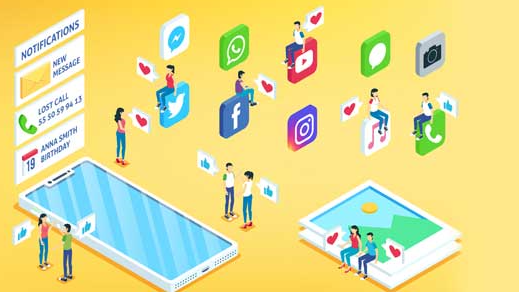
Human behavior has made consumers to turn to social media to get honest reviews or recommendations. Thus, the rise of Influencers, however, as discussed earlier, consumers have caught on to influencers getting paid and don’t trust big influencers anymore, bringing the rise of micro-influencers. Technology has given consumers a new platform to get reviews and recommendations.


Viral Marketing Initiatives

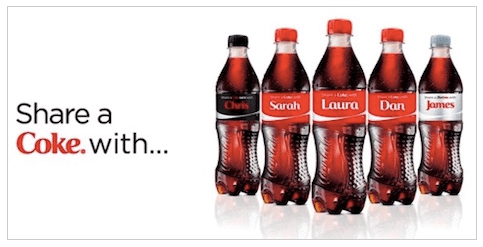
What do you think makes a marketing initiative go viral? Viral marketing is a marketing technique that is intended to trigger a user to perform an act on behalf of the business through word of mouth. Let’ take a look at a viral marketing campaign created by Coca-Cola that launched May 2014.

The purpose of the campaign was to increase sales and it did. Sales actually increased 7% after the launch of the campaign. So what did Coke do that ensured this campaign would go viral? There are FIVE elements of this campaign that contributed to viral success. Here they are:

1) Get to your Know your Audience
Coca-Cola did research to really get to know their audience. The company’s marketing team researched the top 250 names in all countries the campaign was going to launch. As the campaign went on, Coke increased the amount of names on bottles and cans as sales for personalized bottles increased for names not published. They even began to use last names!

2) Research your Target Market
Coca-Cola knew just who to target with this campaign. They knew how to get in front of the right people. “Share a Coke” was meant to target teens and millennials, but the company knew they could reach consumers outside that market. However, they know that teens and millennials are more likely to use social media leading the campaign to go viral. They wanted to reach EVERYONE!

3) Integrate Sharing Capabilities
Coca-Cola created #shareacoke and encouraged consumers to post photos and videos in conjunction with the hashtag on social media. There were more than 500,000 photos and over 2000,000 videos shared on social media by consumers by August 2014 leading to an increase in Facebook followers by 25 million.


4) Connect Emotionally with your Audience
Coca-Cola knew that some names would not be found in stores so they created alternatives to names. People like to feel special. These options were more on a on a personal level. Some alternatives include:
-BFF
-Bestie
-Auntie
-Star
-Soulmate
-Friend
-Dad
-Mom
The list goes on, but all promote on a personal level.

5). Keep it Simple
People like short and sweet. Coca-Cola knew that when creating this campaign. They did not want to overload consumers with mumbo jumbo. It can be overwhelming to see sentences and people will lose interest. “Share a Coke” is short and easy to remember.


Clearly, Coca-Cola knows how to market to consumers and create campaigns intended to reach thousands. Take note of these FIVE elements and use them as lessons learned for your next marketing campaign if going viral is on your agenda.

Set up goals that are realistic, get to know your audience, and connect with them. Make your audience feel something and give them a reason to engage and share.

What are your thoughts about this campaign? Leave your comments below and feel free to subscribe to more blogs!

Differentiation

Social media has become increasingly popular throughout the world over the past years. Not only do people use social media to connect with others, but businesses began to utilize social media in order to engage and connect with society.

There are definitely lessons that can be learned from popular companies in regards to their social media strategies. It’s wise to utilize differentiation in order to understand what works, what does not, and what would work for your specific business.

Let’s take a look at Dunkin’ Donuts and Starbucks. Both are multi-million dollar companies with a vast amount of loyal customers and utilize multiple platforms. Both companies use Facebook, Instagram, Twitter, YouTube, Pinterest, and LinkedIn.

After digging deep into Dunkin Donuts’ social media platforms, it is apparent that their social media focuses heavily on their products. Dunkin Donuts’ Instagram posts consist of about 80% of their posts are pictures of coffees, donuts, bagels, and even Dunkin Donut merchandise such as koozies, mugs, traveler cups, and even apparel. These posts are full of color, bright, and eye-catching.

The Dunkin Donuts Facebook page is full of colors and pictures. It is not used heavily for posting pictures of their products like their Instagram is used for, but they do post photos about their company. There are pictures and posts regarding how they are helping the community and how they are involved in the community. These are very similar to what they use the Dunkin Donuts’ Twitter page for.

Their YouTube focuses solely on advertisement and marketing videos. These generally correlate to the videos they have on Facebook. Their Pinterest site focuses on the fun of Dunkin as a company and their fun products. They have pins for Dunkin Donut nail art, donut decorating, and recipes for sweet treats.

Starbucks focuses heavily on their products, but their posts are minimal and straight forward. Simple, yet classy. Starbuck’s Instagram account is full of pictures, but seems to utilize more infographics and quotes with simple clean-cut pictures.

Their Facebook page focuses on how they are involved in the community. They ensure their followers know that they take pride in their company, support their employees, and involve themselves in current societal situations. Starbucks also integrates their Twitter with their Facebook with similiar engagements.

Like Dunkin Donuts, Starbucks’ YouTube is mainly comprised of advertisement videos as well as short clips of community engagements. The company’s Pinterest includes pins regarding their recipes for their “hidden menu” as well as pins showing crafty mugs and Starbuck’s branded items.

Starbucks and Dunkin Donuts use the different platforms in similar ways, but their content differs. Starbucks is very similar but they have their own marketing strategies. Their posts and sites are not as colorful and fun as Dunkin Donuts, but are equally successful an eye-cathing. Both speak to different types of consumers. However, both companies know their target market and know how to reach and engage with them.

It is important to look into companies and businesses within the same industry in order to gain a clear insight of what works and what does not. Just remember….it is important to use social media for your business in the way that is best for YOUR business and YOUR success.

Want to read more? Enter your email address to follow more of my posts!

Orkut: Success to Failure

Orkut is or shall we say was a social networking site that was launched by Google in 2004 and became very popular in the country of Brazil. Popular in Brazil, yes and for about 10 years. It was shutdown in 2014. But why?

A little background on Orkut. The purpose of the site was to allow users to find different communities through specific worded searches. Once others were found, users could browse through other member’s profiles. In less than 6 months, Orkut had over 50,000 communities. And by 12 months, there was well over 1,500,000 communities.

These communities consisted of users searching for fellow classmates, friends, friends of friends, workplaces, fellow employees, and simply other users with similar interests. The largest community of Orkut were workers and students working with or studying technology.

Google is obviously a well-known company, which is also what attracted users to Orkut. Being involved with Orkut was like belonging to a prestigious community due to the high level technological advances Google is notoriously known for.

So why was Orkut so successful? Well, it was user-friendly. Sophisticated. Clean and simple. Most importantly, owned by Google. This meant that Orkut had the latest and greatest capabilities. Due to the rising number of users and communities, Google needed to find ways to ensure Orkut was meeting the needs and wants of their users.

Google understood what the people in Brazil wanted with Orkut. They knew they needed to involved in order to be engaged and to remain engaged. Users of Orkut had the ability to create blogs and videos marketing campaigns. This made users feel more connected with one another through Orkut.

This integration and implementation Orkut set forth was short-lived. As users increased, Orkut began to create limitations and obstacles for their users. This created tension which led to the failure of Orkut.

In summary, Orkut failed because they stopped allowing their users the freedom they once had. They stopped involving them in their marketing plans. Naturally, users found “better” social networking platforms and Orkut was left to be shut-down and never used again.

Lesson to be learned….INVOLVE YOUR CONSUMERS.


Weixin to WeChat: Above the Rest Putting People First

Whats Weixin? You probably already know since there are well over 300 million people currently using this application on their smart devices. It is a very similar version of the American application, WhatsApp. However, the genius’ behind this app are part of a Chinese company called, Tencent.

Well what makes this networking app any different from any other? Weixin has managed to create and all-in-one app that caters toward the needs of their customers. They know what their users want and they ensured they created an app that does EVERYTHING!

Users do not even need to close the app to do anything. Weixin allows them to send and receive messages, send and receive photos, read the news, call a cab, make purchases, send and receive money, and access their social networks.

Wiexen was constantly putting their users first as they are always making updates to keep their users intrigued and not looking anywhere else for a “better” app. In 2014, Weixin was able to create a campaign in honor of Chinese New Year called “Qiang Hongbao” that allowed users to send and receive the traditional red envelopes associated with Chinese New Year.

In today’s society all over the world, social media and the internet is a way of life. Wiexin knows this and this campaign allowed the population to engage in the tradition in a more modern way. This was genius and a great marketing strategy.

After years of success in Asia, Tencent decided to rebrand Wiexin and launch, WeChat to allow for the app to work on an international level. Again, the app’s purpose it to simplify the user’s everyday life by allowing them to access everything in one app.

According to ClickZ, “60% of their users open the app more than 10 times per day and 21% of users opening the app more than 50 times per day.”  With this information, you can easily gather the usefulness of this app and how it has been embedded into many user’s daily routines.   

This is a company that has ultimately put their users needs and wants into the equation of creating the PERFECT application for any smartphone users, which is nearly everyone. It is crucial that companies are able to identify what their customers want and engrain their necessities into their current and future products or services.


Reference:
Boyd, C. (2017, June 2). An introduction to WeChat: The evolution and future of China’s most popular app. ClickZ. Retrieved March 1, 2020 from https://www.clickz.com/an-introduction-to-wechat-the-evolution-and-future-of-chinas-most-popular-app/111401/


Breast Cancer Awareness Campaign: Do it Right

Social media is the world’s most powerful platform for cyberactivism.  People are able to say what they want and when they want without the fear of the world backlashing or judging them.  It is like an emotional outlet for people to say what they cannot normally say face-to-face.

Sometimes people aren’t even invested in certain campaigns and causes, but they jump on the bandwagon to follow others just because its the trend on social media for that particular time.  This is unfortunate because social media platforms such as Facebook can be utilized to create campaigns that are more meaningful and serve a purpose. 

It is no secret that October is breast cancer awareness month. This is the time everything is pink and everyone shouts to “save the ta-tas” all over social media.  But are these Facebook posts and social media campaigns actually helping with the cause and change the lives of those suffering with breast cancer?

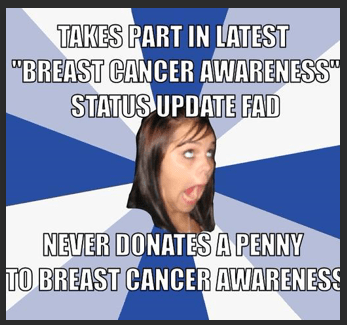
Majority of social media users will follow along with the campaigns, but never donate a penny.  So what is the point of blasting these campaigns and crowding everyone’s news feed?  It all started with a famous campaign that insisted users change they status to their name and the color bra they were wearing.  Just imagine….Nicole Beige.  Does this status make any sense?  Of course not!  Is changing the status making you aware that “Nicole Beige” is supporting breast cancer?  Not one bit.

So others caught on to this trend and status’ were getting seemingly sexual and inappropriate.  Yes, people wanted to join in on the trend for fun.  But again, is this truly reflecting on the fact that October is breast cancer awareness month?  Nope!

How about actually putting more effort into these campaigns that benefit the cause?  Focus more on self-awareness.  Focus on the fact that breast cancer can occur in BOTH female and male.  Stop making it seem that women are the only victims of this life-threatening illness.

Making campaigns that are more at action-oriented would most definitely be more beneficial.  Yes, ensure awareness is spread at all times.  But make an effort to create a campaign that will benefit in the long run.  Millions of random women’s status being changed is not going to cure cancer.  But multiple donations will most definitely help further research that can lead to more effective treatments.

Ultimately, social media is a powerful tool.  Use it to its full potential.

Success of Transactional Communication

Can you imagine starting your own business? What products or services would you offer? Can you imagine starting a successful business with less than $3,000? Well, a group of classmates from the Wharton School of the University of Pennsylvania created Warby Parker. The business focuses on the ease and simplicity of online shopping for eyeglasses and sunglasses.

Warby Parker is not like any other online retail shop. They are able to offer their customers numerous options to choose from to ensure no customer is ever limited to options. They understand their customers like options as it gives them a sense of freedom. However, customers were turned off after the launch of the site.

More choices seemed like the right path, but customers feared the products were of poor quality due to the lower prices compared to that of physical retail stores. They also feared the product was not exactly what they were looking for as they were not able to try the glasses on before purchase. Warby Parker needed to figure out how to stand out.

They created the Home Try-On campaign. Warby Parker will send you multiple pairs of glasses. You try them on. Pick your favorite or favorites. Send back what you do not want. Pay for what you keep. Easy and convenient. How would they market this fantastic campaign and grow their customer base? Warby Parker turned to transactional communication.

Transactional communication allows the constant flow of communication with consumers via their social media platforms. They wanted their customers engaging with them across all social media platforms such as Facebook, Twitter, and Instagram by posting photos of themselves in hopes that others would be intrigued and search for Warby Parker. It worked!

It is important for businesses whether small or large to utilize social media. This does not mean you need to sell products and services online. It simply means to create a meaningful relationship with your customers. Keep them engaged through social media. Create posts that are interesting and that your target audience might want to read.

Social media has been around for a long time and it is only going to continue to grow. Use all the marketing resources available. Your business will only succeed.

Design a site like this with WordPress.com
Get started